
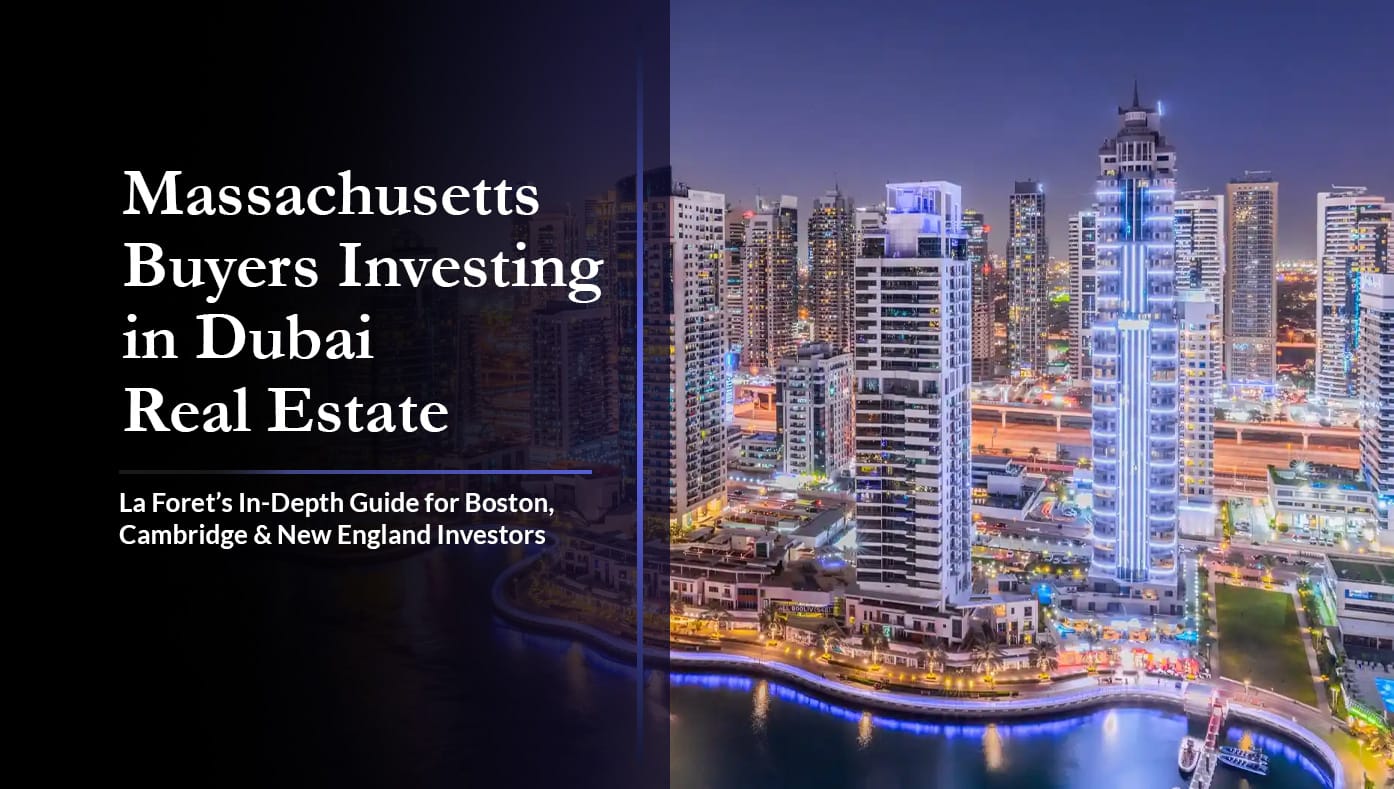

Massachusetts Buyers Investing in Dubai Real Estate | La Foret’s In-Depth Guide for Boston, Cambridge & New England Investors
Why More Buyers From Boston, Cambridge, Brookline, Newton, Lexington & Across Massachusetts Are Moving Capital Beyond New England and Into Dubai’s Tax-Free Global Property Market
If you’re reading this from Boston, Cambridge, Brookline, Newton, Lexington, Wellesley, Quincy, Somerville, or anywhere else in Massachusetts, you already know how demanding and capital-intensive the local property market has become.
Massachusetts real estate has long been viewed as “safe” and prestigious. World-class universities, top healthcare institutions, a powerful biotech and tech ecosystem, and consistent demand have supported high property values for decades. But as we move into 2026–2027, many Massachusetts property owners are starting to question efficiency—not desirability.
Across the state, investors are increasingly dealing with:
- Extremely high purchase prices in Boston and surrounding suburbs
- Some of the highest property taxes in New England
- State and federal income tax on rental profits
- Strict regulations and tenant-protection frameworks
- Rental yields that often lag behind total ownership costs
For many owners, the issue isn’t demand—it’s return on effort and capital.
That’s why a growing number of Massachusetts buyers investing in Dubai real estate are now expanding their strategy internationally, using Dubai as a tax-efficient, high-yield counterbalance to heavily taxed New England assets.
Dubai offers something Massachusetts simply cannot in 2026–2027:
- 0% annual property tax
- 0% rental income tax
- 0% capital gains tax on property resale
- 6%–9% net rental yields in prime Dubai communities
- USD-pegged currency (AED) for financial stability
- A global city built for business, mobility, and investors
At La Foret Real Estate, we work closely with Massachusetts-based clients—biotech executives, physicians, university-affiliated professionals, venture-backed founders, finance leaders, retirees, and globally minded families—who want their capital to perform with less friction and stronger long-term compounding.
Before diving deeper, many Massachusetts investors first explore Dubai Real Estate Investment, review Best Real Estate in Dubai, and gain broader context through Dubai Real Estate for Global Buyers.
Why Massachusetts Investors Are Looking Beyond Boston — And Choosing Dubai in 2026–2027
The rise of Massachusetts buyers investing in Dubai real estate is not driven by trends or speculation—it’s driven by math, taxation, and long-term planning.
1. High Property Taxes and Regulation in Massachusetts
Massachusetts property owners are well aware of the cumulative cost of ownership. In and around Boston, investors face:
- High effective property tax rates
- Local surcharges and assessments
- Strict zoning, rent regulation discussions, and tenant protections
- Lengthy and expensive compliance requirements
By comparison, Dubai offers clarity and simplicity:
- No annual property tax
- No rental income tax
- Clear landlord-tenant regulations
For Massachusetts investors used to layered regulation, Dubai’s framework feels refreshingly direct.
2. Yield Compression in Boston vs. Dubai’s Cash-Flow Model
In many Boston-area neighborhoods, even strong gross rents are offset by:
- High acquisition costs
- Property tax and state income tax
- Maintenance on older housing stock
As a result, net rental yields often land between 2.5%–4%.
In contrast, within Dubai’s best areas to invest in property, Massachusetts buyers frequently achieve:
- 6%–9% net rental yields
- Tax-free rental income
- Strong occupancy from global professionals
For investors focused on income efficiency, this difference compounds rapidly over time.
3. Older New England Housing vs. Modern Dubai Developments
Much of Massachusetts’ housing stock is older, which brings:
- Higher maintenance and renovation costs
- Heating, insulation, and infrastructure upgrades
- Insurance considerations tied to aging buildings
Dubai developments, by contrast, are typically:
- New or recently built
- Professionally managed
- Designed with predictable service charges
For Massachusetts investors managing multiple properties, Dubai ownership often feels significantly more streamlined.
4. Boston vs. Dubai: Academic Hub vs. Global Connector
Boston is one of the world’s most important academic and medical hubs. Dubai plays a different role—it connects global business, trade, and talent across continents.
Dubai’s real estate demand is fueled by:
- International corporate relocation
- Tourism and year-round events
- Professional migration from Europe, Asia, Africa, and the Middle East
For Massachusetts buyers investing in Dubai real estate, this means exposure to demand drivers well beyond the U.S. economy.
5. Strategic Diversification for High-Net-Worth Families
Many Massachusetts investors hold concentrated exposure to:
- S. equities and venture capital
- Biotech and technology compensation
- Local New England real estate
Dubai provides:
- Geographic diversification
- A dollar-pegged international market
- Protection from U.S.-only policy and tax shifts
For long-term perspective, investors often follow Dubai Real Estate Trends and Dubai Investment Opportunities.
Where Massachusetts Buyers Prefer to Invest in Dubai
Massachusetts investors are analytical, quality-driven, and long-term oriented. These Dubai communities consistently attract their interest.
1. Downtown Dubai — Global Visibility & Institutional Demand
Downtown Dubai appeals to Boston-area investors who value:
- Landmark locations like Burj Khalifa
- Luxury branded residences
- Strong corporate and tourism-driven rental demand
2. Dubai Marina — Consistent Cash Flow & Liquidity
Dubai Marina is favored for:
- High occupancy rates
- Professional expat tenant base
- Excellent resale liquidity
3. Dubai Hills Estate — Structured Living for Families
Dubai Hills Estate resonates with Massachusetts families seeking green space, planning discipline, and long-term livability.
4. Palm Jumeirah — Prestige Assets With Scarcity Value
Palm Jumeirah attracts high-net-worth buyers focused on legacy assets and capital preservation.
5. Al Barsha — Practical Neighborhoods for Extended Use
Al Barsha real estate suits buyers considering longer stays, schooling, or partial relocation.
Off-Plan vs Ready Property for Massachusetts Buyers
Off-Plan Properties (Under Construction)
- Lower launch pricing
- Flexible 2–5 year payment plans
- Strong appreciation potential
Ready Properties (Completed Homes)
- Immediate rental income
- Proven yield and occupancy data
- Immediate lifestyle use
Most buyers compare both paths using the Off-Plan Properties Dubai Investment Guide and Buy, Sell & Rent in Dubai.
How La Foret Supports Massachusetts Investors
At La Foret Real Estate, we act as long-term advisors—not transactional brokers.
- Massachusetts-friendly, remote-first communication
- Data-driven property shortlists
- End-to-end transaction coordination
- Full property management and leasing services
- Complete transparency on costs and timelines
Many clients also review Dubai Top Luxury Real Estate Agency, Top Rated Agents in Dubai, and Licensed Property Consultants in Dubai.
Final Thoughts: Why Massachusetts Buyers Are Entering Dubai Now
Massachusetts investors understand discipline, research, and long-term value creation. Dubai offers a rare combination of tax efficiency, global demand, income clarity, and future-focused infrastructure.
Your wealth doesn’t need to remain confined to one region or one tax system.
Dubai allows Massachusetts buyers to build a globally diversified, tax-efficient real estate portfolio—while maintaining their professional and family life in New England.